Writing an idea
Unknowns and Not doing
Unknowns are the questions you can’t answer yet, whose answer would change what gets built. Not doing is what you’re leaving out on purpose. Both are lists you keep wherever the thought comes up: on the idea page, or on any other written page.
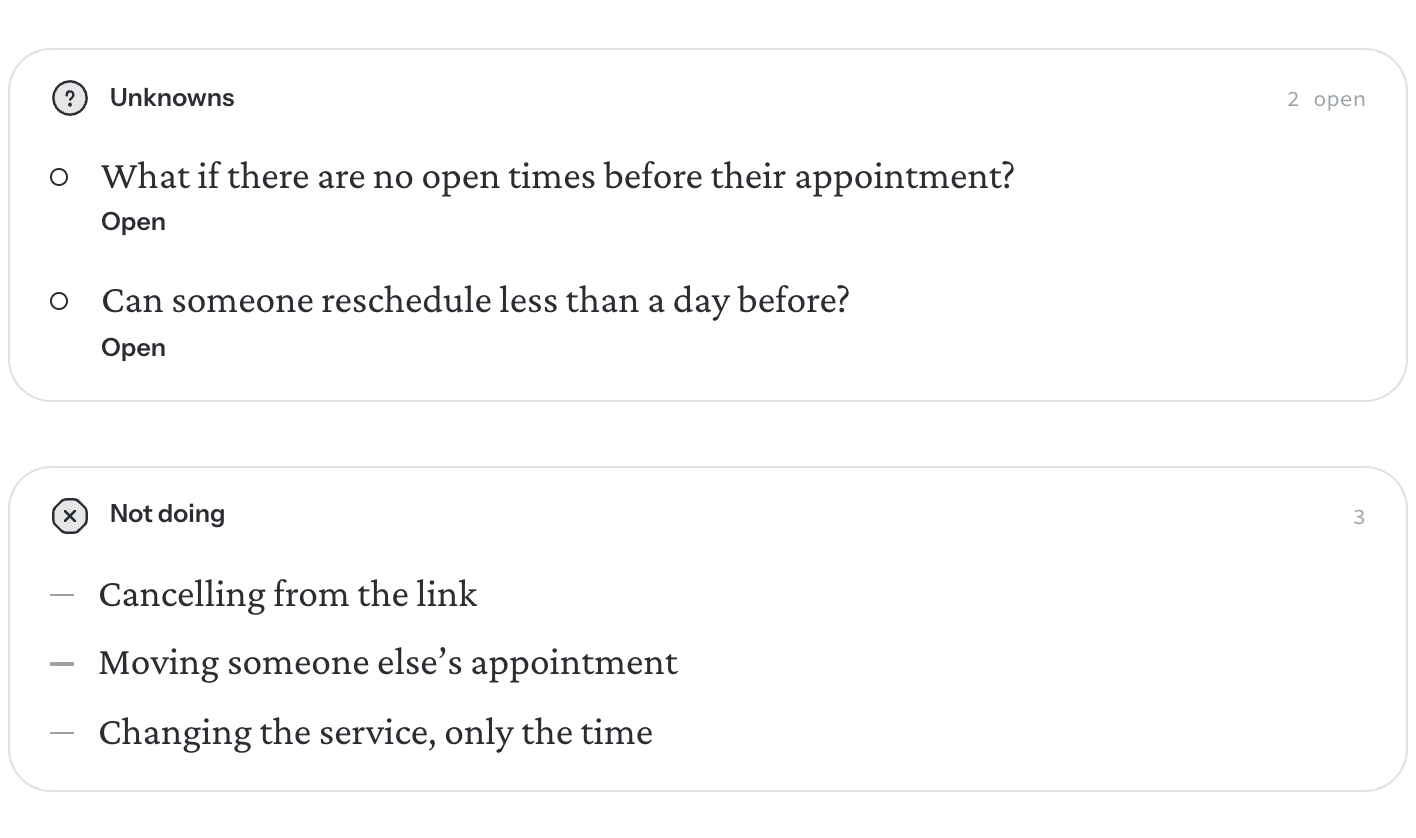
The two boxes
Each list sits in a box of its own, with its sign and its name at the top and a count beside them.
- Unknowns. Each line is one question. A hollow dot means it’s still open, a filled dot means it’s settled, and the count says how many of each.
- Not doing. Each line is one thing you’re leaving out. Say why as well as what: the reason tells whoever builds it where the edge is.
Choose Add an unknown or Add something you’re not doing to add a line. Enter at the end of a line starts the next one, Enter on an empty line takes you out of the box, and the × beside a line removes it.
Write a question as you go
You don’t have to stop and find the box. Start a line with ?, write the question, and press Enter. For example: ? Do refunds go back to the original card?
- On the idea page, the question joins the page’s Unknowns (Walden adds the box if there isn’t one), and your line is empty again for the next thought.
- On any other page, it becomes an unknown right where you wrote it: it joins a box just above or below, or starts a new one there.
Undo (⌘ Z, or Ctrl Z on Windows) puts the line back as you wrote it.
Close an unknown
Under an open unknown are three ways to close it. Each leaves a line that whoever builds the idea reads:
- Settle it
- You’ve decided. Write what you decided beside Settled, and the dot fills.
- Leave it to the builder
- It’s theirs to decide. It’s settled with the line “Left to the builder.”, which you can add to.
- Rule it out
- It’s out. It moves to Not doing on the same page, where you can say why.
Clicking a hollow dot settles it too, and asks what you decided. Click a filled dot to open it again.
Lists on other pages
The idea page keeps one of each box at most. Any other written page can keep as many as it needs, right beside what raised them: type / and pick Unknowns or Not doing under Parts of the idea. Boards and UI sketches don’t hold them.
The idea’s unknowns are every page’s, and so is its Not doing. The idea page shows the other pages’ under its own, under On other pages, page by page; click one to go there. The count at the top of the box is the whole idea’s, and so is what the readiness strip reads. See Pages.
Nothing open, on purpose
When an idea truly leaves nothing open, say so rather than leaving the box empty. On the idea page’s box, with nothing in it on any page, choose Nothing open: the box says “Nothing open. Everything here is decided.” and the part isn’t counted. Not doing has Nothing to rule out the same way. An unknown added on any page takes it back.
Keep a question someone asked
A question a second reader asked, or one a colleague left in the margin, can become one of your unknowns. Choose Add as an unknown beside it. On the idea page it joins the Unknowns; on any other page it goes right beside the block it was asked about. From then on it’s yours, like any unknown. See The second reader and Writing together.
Chat can draft unknowns and things to leave out, too. They land as drafts on the page chat is open on, and count once you keep them. See Drafts.
What reads them
The readiness strip reads every page’s: Unknowns are Ready once each one is settled, left to the builder or ruled out, and Not doing once each line says why. When you hand the idea off, Walden lists every open unknown by the page it’s on, and whoever builds it gets every page’s, open and closed. See Readiness and Handing off.
What you settled and ruled out is kept when the idea is handed off, and a later idea that goes against it gets a question in the margin. See Decisions from earlier ideas. A coding agent reads the lists too: it asks where an unknown is still open, and chooses, and says what it chose, where you left it to the builder. See Following a build.